

For governments, groups and alliances
One essence, many entities
What each entity is responsible for, how it is implemented, where they overlap and what a change will affect, with every fact backed by its evidence.
The problem
More entities than any one architect can hold in their head
Duplicated investment
The same outcome gets funded in two or three places, because nobody could see it was the same outcome.
Fragile change
A change in one entity travels along dependencies into others that were not in the room.
Unaccountable decisions
Decisions are taken whose reasons were never recorded against the evidence.
What it is
One place to understand every entity you manage
A government is a federation of departments, authorities and funds. A corporate group is a set of subsidiaries and divisions. Each documents itself in its own vocabulary, so two entities doing the same job look different, and group-level questions go unanswered.
Red Bear: Enterprise Ontology Management gives a federated group one place to discover, capture, check and maintain the ontology and architecture of every entity it manages, partners with or measures itself against. Which entities issue licences, and with how many systems? Which vendor is in all of them? What does this change affect?
How it works
Five pillars, useful alone and better together
Knowledge and evidence
Every fact is an assertion with evidence and a confidence level. Conflicts are raised, never dropped.
Understanding the enterprise
Managed, partner and baseline entities, with questionnaires, workshops and read-only connectors.
Analysis
Overlap by function with the duplicated spend behind it, impact analysis, maturity, and a completeness score per entity.
Decisions and recommendations
Patterns proposed with their reasons and trade-offs, and questions answered with citations or refused.
Roadmap and governance
Transition timelines that respect dependencies, consolidation candidates, and an audit of every read and refusal.
What makes it different
One essence, many entities
Compared by what they do
A unit of work is defined once and used by any number of entities without being copied, so overlap is found by function, not by name.
No merged model
Every cross-entity view is computed from the facts. No entity's truth is overwritten by another's.
Provenance, then authority, then a person
AI extraction starts as inferred. Only a named person can confirm a fact, accept a recommendation or approve a change.
Two reviewers on intake
Questionnaires and documents need two reviewers, and the system administrator runs the tenant without seeing its content.
How you adopt it
A first quarter of establishment
Connect (weeks 1 to 2)
Tenant, roles and read-only connectors, with your own standards loaded as the highest authority.
Discover (weeks 2 to 4)
Entities registered, giving an honest statement of how much is known about each.
Understand (month 2)
Questionnaires, submissions and workshops, with AI extractions reviewed by two people.
Compare (months 2 to 3)
The shared essence is modelled capability by capability, producing the first overlap and duplicated-spend reports.
Govern (month 3 onward)
Cross-entity review, with changes classified and routed, and decisions recorded with their impact.
See it working
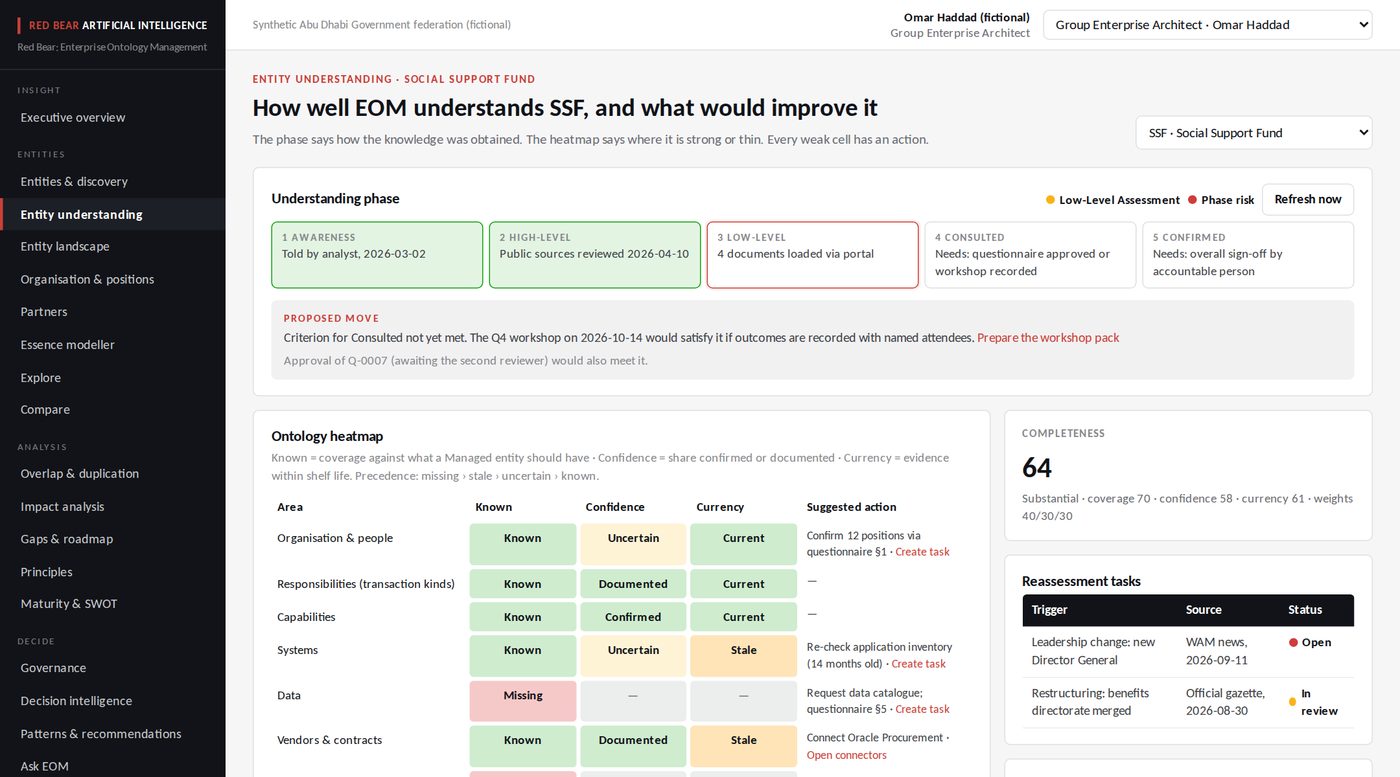
A real screen from the working prototype
Shown with synthetic data for fictional organisations.
Read further
11 documents on this product
No form, no email address. The link downloads the PDF.
- White paper: Enterprise Ontology for Federated OrganisationsEOM-WP-01 · v0.1
- White paper: Enterprise Ontology for Inter-Entity AutomationEOM-WP-02 · v0.1
- White paper: Enterprise Ontology Maturity and BaseliningEOM-WP-03 · v0.1
- White paper: Enterprise Architecture Roadmap HarmonisationEOM-WP-04 · v0.1
- White paper: Enterprise Architecture Decision IntelligenceEOM-WP-05 · v0.1
- Data sheet: Suite overviewEOM-DS-00 · v1.0
- Data sheet: Knowledge and evidenceEOM-DS-01 · v1.0
- Data sheet: Understanding the enterpriseEOM-DS-02 · v1.0
- Data sheet: AnalysisEOM-DS-03 · v1.0
- Data sheet: Decisions and recommendationsEOM-DS-04 · v1.0
- Data sheet: Roadmap and governanceEOM-DS-05 · v1.0
Running more entities than anyone can hold in their head?
Tell us how many are in your group and what you most need to understand across them.