

For leaders changing how teams work
Move from a blame culture to a learning culture
Culture Dials for the principles leaders choose, pattern analysis from aggregated signals, and coaching for the owner of a pattern. Patterns, never individuals.
The problem
Information stops moving when people are afraid of what it will be used for
Values nobody can measure
Leaders name values, and every team hears a different five. The survey says 3.7, and nobody knows what to do on Monday.
Feedback arrives as a verdict
So managers defend themselves instead of learning. Culture change becomes a poster campaign with no plan behind it.
Problems found too late
Toxic patterns surface in exit interviews a year on, and nobody can say whether the programme moved anything, so it is cut.
What it is
From a blame culture to a learning culture
A blame culture is one where the answer to failure is a person. A learning culture is one where the answer is a change to the system, owned by a named person. Red Bear: Enterprise Culture Evolution moves an organisation along that line.
Leaders choose the few principles that matter, and each becomes a Culture Dial with a target, a lever and an owner. The product reads the dials from stories staff choose to share, outcomes that are hard to game, and a quarterly pulse. It then invites the owner of a pattern to a private coaching session, and helps build a programme that can be measured.
How it works
Eight pillars, one per function
Principles and Culture Dials
The C-level chooses up to five principles from a catalogue of fifty culture aspects, and each manager chooses up to three within them.
Signal intake
Stories, a monitored mailbox and a public page are coded to aspects on arrival, and the text is discarded.
Findings and patterns
What sits behind a dial, framed as a question to its owner, and suppressed when the group is too small.
Coaching
A disclosed Socratic session for the owner of a pattern, with a named human one request away. Only the lesson is kept.
Programme and communications
A programme per group, a pilot with a comparison before scaling, and drafts that are never sent unapproved.
Health monitoring
Toxic patterns and burnout indicators per unit above the floor. Abuse and harassment go to HR as a proposal, never to a coaching session.
Measuring the programme
Six measures, with the pilot read against its comparison, so you can see whether anything moved.
Governance and consultation
A consultation view, a staff notice and an impact assessment. No connector reads anything until they exist.
Patterns, never individuals
Built so the intrusive feature cannot exist
Aggregated first
Signals are grouped above a minimum size before any analysis runs: at least five for scores and ten for free text.
No text kept
Submitted text is coded on arrival and discarded. Collaboration data is headers and counts, never message bodies.
Nobody can look below the floor
No screen, export or API names a person against a signal. That includes administrators, because no such row exists.
AI proposes, a person decides
A named person sets the target, adopts the programme, approves the communication and records the lesson.
How you adopt it
Consultation first, then evidence, then scale
Consult
Workers' representatives review what the product will read and keep. The impact assessment and staff notice are written before anything connects.
Choose five
A named C-level sponsor chooses up to five principles and names a lever for each. Managers choose three within them.
Pilot on evidence
The programme runs first on matched units, with the outcomes recorded before it starts.
Scale
Extension is a sponsor decision, taken on dial movement against the comparison. Elements that do not move a dial are retired.
See it working
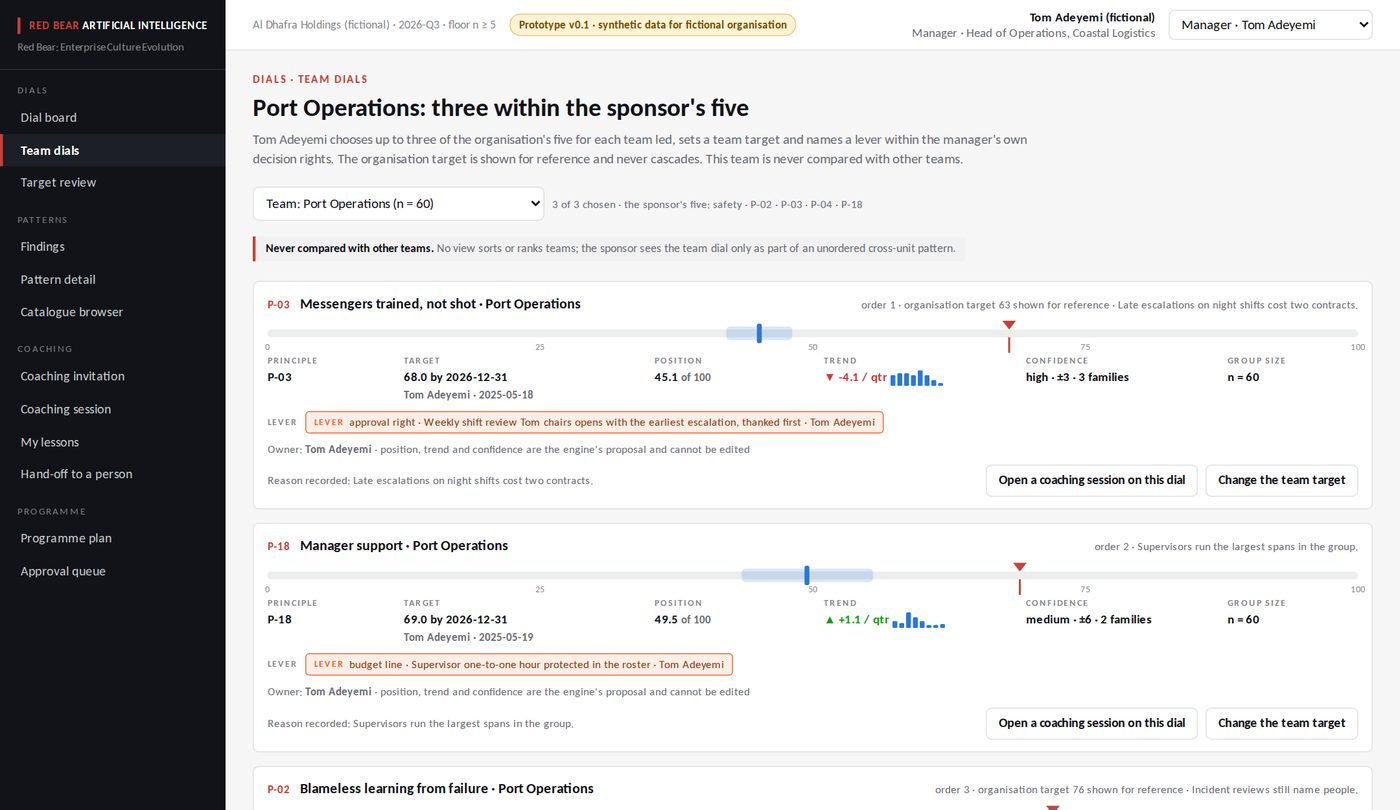
A real screen from the working prototype
Shown with synthetic data for fictional organisations.
Read further
13 documents on this product
No form, no email address. The link downloads the PDF.
- White paper: Culture Coaching Without SurveillanceECE-WP-01 · v0.1
- White paper: Culture Analysis Without IndividualsECE-WP-02 · v0.1
- White paper: Privacy, Trust and No-AttributionECE-WP-03 · v0.1
- White paper: Breaking Down SilosECE-WP-04 · v0.1
- Data sheet: Enterprise Culture EvolutionECE-DS-00 · v0.1
- Data sheet: Principles and Culture DialsECE-DS-01 · v0.1
- Data sheet: Signal intakeECE-DS-02 · v0.1
- Data sheet: Findings and patternsECE-DS-03 · v0.1
- Data sheet: CoachingECE-DS-04 · v0.1
- Data sheet: Programme and communicationsECE-DS-05 · v0.1
- Data sheet: Health monitoringECE-DS-06 · v0.1
- Data sheet: Measuring the programmeECE-DS-07 · v0.1
- Data sheet: Governance, consultation and administrationECE-DS-08 · v0.1
Considering a culture programme?
Tell us who is sponsoring it and what has prompted it, and we will tell you whether we can help.